Saturday, November 05, 2011

Raccoon Ridge Delaware Water Gap, Hawks and American Chestnuts

Today was a bright, clear and brisk day for a hike to Raccoon Ridge at the Delaware Water Gap. The day was cool, so we needed lots of layers, but there was not much wind so it was a very comfortable hike.
View from the ridge

Brian Hardiman, the official counter for the Raccoon Ridge Hawk Watch, spoke to us about raptor identification. He told us how to identify the major groups: accipiters, buteos, falcons, eagles, harriers, osprey, and vultures. They are identified by silhouette, and also flight patterns and behavior. With some more expertise, the exact type of bird is identifiable. He also told us about the migration cycles and which birds come through at particular times of year. November is the time for Red-Tailed Hawks and Golden Eagles.

Brian spoke to us about the history of Raccoon Ridge. There has been a hawk count at the ridge for nearly as long as Hawk Mountain, which dates back to the 1930s.

I asked Brian some questions about hawk conservation. There really are mixed results. Many bird populations are actually increasing, due to increased awareness of pesticide dangers, improved water quality, and even re-introduction programs for Bald Eagles. This year there were record counts of Broad-Winged Hawks. Other populations are decreasing and their migration patterns are impacted by climate change. Hawk counts such as the one at Raccoon Ridge are important to identify these patterns and potential environmental threats, and also for education (perhaps inspiring future environmentalists!), and of course, recreation and the enjoyment of viewing nature.

Counts from Raccoon Ridge and many other hawk count sites are found at Hawkcount.

Another view from the ridge

The browns and golden colors of November are visible.

The river below

Look! In the sky! A hawk!

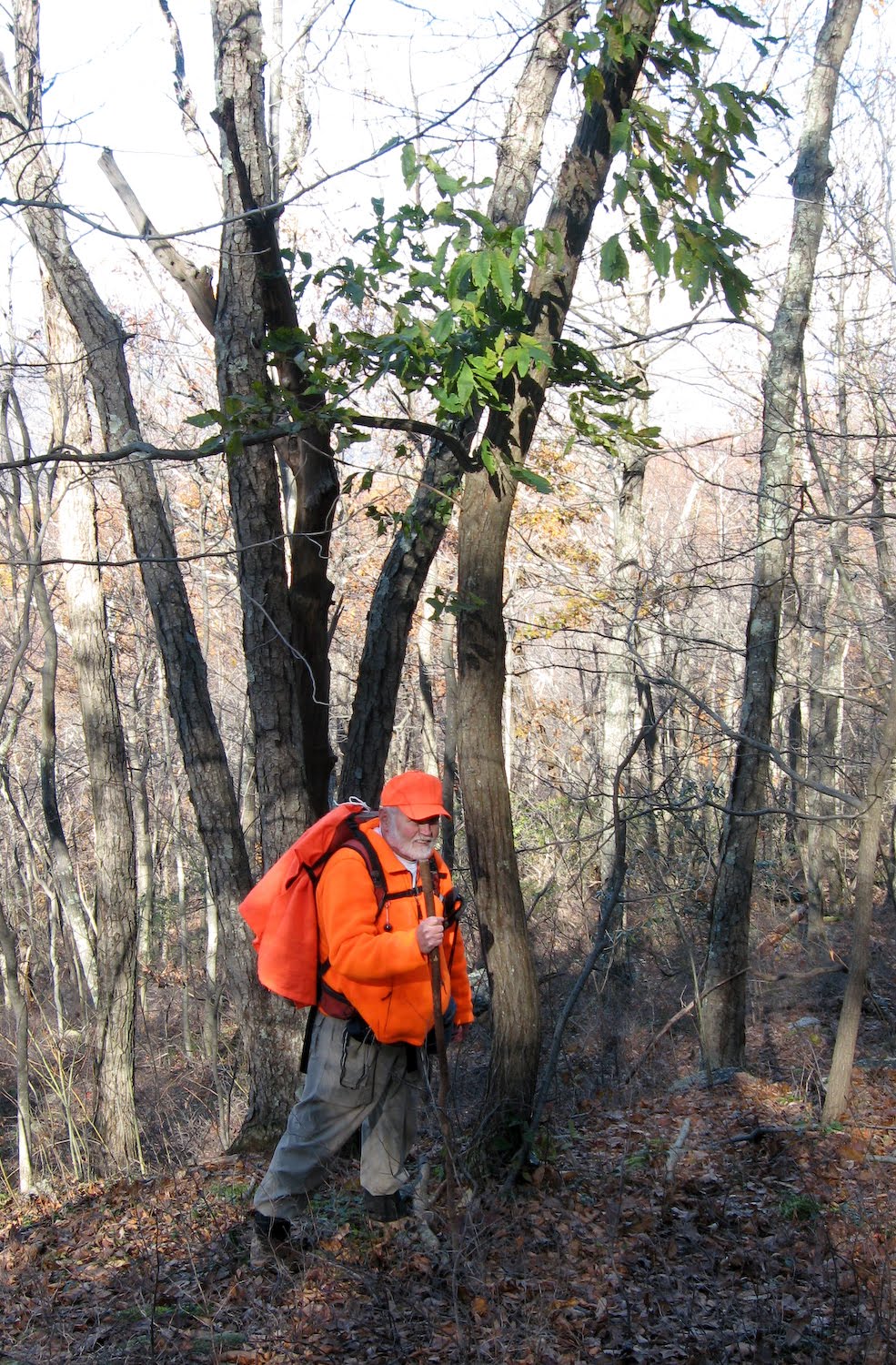
Mike Manes also explained to us the dire situation of the American Chestnut. The American Chestnut was once a prominent and common tree in the hardwood forests. The population was nearly decimated in the early 1900s with the introduction of a non-native blight. The blight either kills the tree outright, or severely stunts its growth. Almost all Chestnut trees in the Eastern forests are infected by the blight. Here Mike is standing by a Chestnut tree. In the past these trees were over one hundred feet tall and up to ten feet in diameter. You can see how the blight stunts the growth. Signs of blight were visible on this tree. More information is available at the American Chestnut Foundation, a group trying to reintroduce the American Chestnut into the Eastern forest.

Today was a fabulous day for hiking and also learning about our environment, how it is changing, and how we can work to protect it!

Labels: ,

Saturday, February 12, 2011

Bahá'í Community of Lehigh Valley Participates in Interfaith Action Day On Global Warming


Today the Baha'i Community of the Lehigh Valley participated in Interfaith Power and Light's "Interfaith Action Days on Global Warming" by having a devotional gathering, educational talk, and brunch.

We gathered at Mary Anne and Richard Rood's home and had a lovely breakfast with friendship, fellowship, and lots of conversation.

After listening to some inspirational Native American flute music by Kevin Locke, we had a lovely devotional emphasizing themes of nature, beauty, justice, and unity.

Whatever I behold I readily discover that it maketh Thee known unto me, and it remindeth me of Thy signs, and of Thy tokens, and of Thy testimonies. By Thy glory! Every time I lift up mine eyes unto Thy heaven, I call to mind Thy highness and Thy loftiness, and Thine incomparable glory and greatness; and every time I turn my gaze to Thine earth, I am made to recognize the evidences of Thy power and the tokens of Thy bounty. And when I behold the sea, I find that it speaketh to me of Thy majesty, and of the potency of Thy might, and of Thy sovereignty and Thy grandeur. And at whatever time I contemplate the mountains, I am led to discover the ensigns of Thy victory and the standards of Thine Omnipotence.
- Bahá'u'lláh


Every created thing in the whole universe is but a door leading into His knowledge, a sign of His sovereignty, a revelation of His names, a symbol of His majesty, a token of His power, a means of admittance into His straight Path....
-Bahá'u'lláh,


O son of man! If thine eyes be turned towards mercy, forsake the things that profit thee and cleave unto that which will profit mankind. And if thine eyes be turned towards justice, choose for thy neighbor that which thou choosest for thyself.
- Bahá’u’lláh

Every age hath its own problem, and every soul its particular aspiration. The remedy the world needeth in its present-day afflictions can never be the same as that which a subsequent age may require. Be anxiously concerned with the needs of the age ye live in, and center your deliberations on its exigencies and requirements.
- Bahá'u'lláh


Afterward, Eric Romo presented a very educational and fascinating talk on the exponential growth of solar energy, its economic and environmental advantages, and its usefulness in addressing our energy needs in a sustainable way. Eric is Vice President of Strategic Development at GreenVolts, a company providing scalable, reliable, high performance solar energy. There were many questions and lots of discussion.


Then we listened to Dan Fogelberg's "Earth Anthem"

And we are but an island
In an ocean
This is our home
Third from the sun
Let it be evergreen
Let it be evergreen
And we are but an island
In an ocean
This is our home
Third from the sun
God, keep it evergreen
To keep it ever green
I would lay my life down
And we are but an island
In an ocean
This is our home
Third from the sun
Let it be evergreen
Let it be evergreen


We had a very inspirational and educational morning, reflecting on the spiritual requirement to care for Earth and all of its diverse inhabitants, and discussing a very practical plan of action.

Labels: ,

Tuesday, April 13, 2010

We Are A Community - Lessons from No Impact Man


No Impact Man is a documentary about a family attempting to live for a year making no negative impact on the environment. Colin Beavan, his wife Michelle Conlin, and their daughter Isabella live in New York City. During the project, they attempt to make little or no trash, buy nothing but food, eat only locally, use only bikes for transportation, compost all their garbage using a worm bin, give up elevators, television, and eating out, and even ultimately turn off the electricity to their apartment. Any negative impact on the environment is offset by positive action, such as volunteering for a project restoring oysters to the Hudson River for water filtration.

The movie gave a lot of information about our impact on the environment. But the most interesting part of the film to me was the evolution of the relationship between Colin and Michelle. Initially, Michelle was skeptical and reluctant, and few habits die hard, such as the daily cup of non local coffee. During the course of the year Michelle is transformed by the effort to live intentionally and simply; she said the best part of the project for her was the intimacy in her family. Colin is transformed as well as he helps Michelle live out her own dreams. They grow closer without the diversions of television, restaurants, and lights and electricity. They spend more time outside as a family during the hot New York summer. Their friendships deepen over home made meals, games of scrabble and charades, and meaningful conversation.

The main lesson of the film, for me, was the importance of community for social change. Colin speaks about community:

People ask me, "If I can just do one thing, what should it be? Not use plastic bags or not use plastic cups?" I would say if there was only one thing to do it would be to volunteer with an environmental organization. Part of the reason for that is because there's community. I believe very strongly that a lot of the environmental problems in our planet have come because of the breakdown of community. Because without community none of us feel accountable to anybody else. All of us are interconnected on many levels. If you're religious, then you understand that at a religious level. But even if you're just practical, you can see that we're interconnected. If I splash a puddle and you're standing next to it, it splashes you. If I make pollution you have to breathe it in. My mind wants to tell me that I'm the only one that's important, you know? So I have to keep teaching myself over and over and over again that that's not true.

At the end of the project, Michelle spoke about what changes she would like to maintain. Her list included biking, little or no garbage, the farmer's market, eating mostly vegetarian (with a hot dog now and then), and no television in the house. The first thing she wanted to get rid of was the composting worm bin in the kitchen!

No Impact Man was very thought provoking. The project inspires us to look at our own daily lives and discover how we can lessen our negative environmental impact and increase our benefit to the planet. We can also ask ourselves how we can become closer to our families, friends, and neighbors and build close knit communities. As we learn to care for each other, we naturally want to take care of our environment which sustains all of us.

For more info, see the No Impact Project.

Labels: ,

Thursday, October 15, 2009

Blog Action Day 2009 - Climate Change


Today on Blog Action Day 2009 I am joining my voice with thousands of bloggers who will be posting about the topic of climate change based on their own perspective and interests.

Solving the problem of climate change can only be based on our recognition that we are one human family sharing a collective fate. We need to mature as a human race and learn to solve problems cooperatively or we will face the consequences of irreparable damage to our environment.

As individuals, we will need to learn to take responsibility for the future of our community. Our individual actions and choices impact the entire world. For perhaps the first time we will have to view the Earth as our common homeland. Because our actions affect the climate, they can impact drought, hunger, and famine in all parts of the globe. We will also have to bear responsibility for our impact on future generations.

Not only must we mature as individuals, but as a community we must learn to solve problems cooperatively. We will need all of our collective knowledge and wisdom from the various fields of human expertise. We must learn to consult with each other and benefit from our diverse opinions.

We must also realize the power of unbiased scientific investigation. Science constrained by political motivations or traditions cannot be effective. We must learn to see things as they really are.

The unequal distribution of the impact of climate change is also a matter of justice. Affluent nations have a greater contribution to climate change because of their higher levels of consumption, while less developed nations disproportionately bear the consequences. They are more vulnerable to natural disaster and have less ability to cope with diminishing resources. As a human family, we must decide who is responsible for making changes and how we can help each other shoulder the impact. All of these decisions need to be made collectively.

These are difficult tasks for a human community struggling with disunity, conflict, materialism, lack of education, and competition for global resources. Solving climate change is not just about recycling bottles or turning off lights, important as these actions are. The real challenge is to change how we view ourselves as a human race, how we relate to our neighbors, and how we solve problems as a community.

How can we begin to accomplish this? Perhaps the best place to start is the education of our children. We can encourage scientific achievement and problem solving skills, and also cultivate an attitude of service to humankind and an appreciation of the human family and the environment in which we live. Another place to take action is at the level of our communities. Let's encourage participative problem solving and openness to diverse opinions in whatever community group we are serving in. Many of the changes required must occur in business and government, but we can facilitate these changes in our own professions where appropriate and also with our votes, letters to our representatives, and the purchasing power of our dollars.

The challenges are many and the risks are great. If we cultivate an attitude of responsibility for the entire human race with which we share this planet and the future generations we will bequeath it to, we can use our collective knowledge to come up with creative and comprehensive solutions. In so doing, we may even find that we enter a new stage in our social development, the realization of our unity as a human family.

Learn more!

Labels: ,

Saturday, September 19, 2009

Pennsylvania Renewable Energy and Sustainable Living Festival

Today I went to the Pennsylvania Renewable Energy and Sustainable Living Festival in Kempton. There were hundreds of exhibitors displaying products and information on alternative energy technology, organic gardening, sustainable living, environmental education, and more. I received a lot of advice on using native plants to landscape my garden, how to use a solar fan to cool my attic, and how to contact my representative regarding a clean energy bill. I also did a little shopping and bought a fair trade bracelet from Ghana made from recycled materials.

I ate some vegetarian Thai peanut noodles for lunch with a vegan peanut butter brownie for dessert, all animal friendly and Earth sustaining!

I listened to three of the dozens of lectures. I learned about the environmental risks to the water supply from drilling for natural gas, I learned why wind energy is a viable source of energy and how buildings can become self sustaining with wind turbines, and I learned some theories explaining why bees are disappearing!


The view from Kempton - a beautiful day for a festival

The main speaker Saturday afternoon was Brian Tokar who spoke about "Renewing Energy and Renewing Society".

The evening's entertainment included traditional Japanese percussion performed by Makoto Taiko.


Paul Winter performing on saxophone. Winter incorporates sounds of nature and wildlife into his songs, he included recordings of whale songs, wolves, birds, and elk.

Labels:

Sunday, August 30, 2009

Green Acre Bahá'í School, Eliot, Maine, August 21 to 23

I had a refreshing visit to Green Acre Bahá'í School in Eliot, Maine.

The program I attended was Alternative Energy - Material and Spiritual, led by Larry Staudt, director of the Center for Renewable Energy at Dundalk Institute of Technology, Ireland.
I am very interested in the connection between environmental protection and faith because I think the change in behavior required to protect our environment is motivated by a fundamental change in values: religious, spiritual, and secular. I am encouraged by the number of faith communities working for environmental sustainability.

Larry drew many parallels between the spiritual and material worlds as levels of one creation. Baha'is view their collective purpose as carrying forward an ever advancing civilization, and in order to do that, of course, we must sustain and protect our environment for future generations and all of the world's cultures. We also talked about the independent investigation of truth and the importance of scientific investigation and study.

In addition to spending time discussing the spiritual realm, we also talked about sustainable energy technology. Larry was instrumental in installing the world's first large commercial wind turbine located on a college campus at Dundalk Institute of Technology, which provides half the electricity for the campus. We also talked about the particulars of a passive solar home, using Larry and Dawn's home as an example.

I met many new friends at Green Acre, we formed instant connections because of our common values and our interest in protecting the environment. We shared a lot of discussion and a lot of laughter. I had a wonderful time learning, discussing, meditating, and absorbing the spiritual energies of Green Acre.


The Sarah Farmer Inn where I stayed. ‘Abdu’l-Bahá visited Green Acre in 1912. Bahá'ís pray and meditate in the room where he stayed and are inspired by the spiritual energy of his presence.

Interestingly, Swami Vivekananda, credited with bringing Hinduism and Yoga to America, visited Green Acre in 1894. The Boston Vedanta Society, followers of Vivekananda, also had a retreat at Green Acre this weekend. We had several wonderful discussions over meals.

Porch overlooking the Piscataqua River. Sarah Farmer's vision for Green Acre was to focus on "world peace, the equality of women and men, racial unity, and spiritual transformation" (see History of Green Acre). One can only imagine all the discussions held here.

A place to relax

Beautiful flowers

Labels: ,

Tuesday, June 16, 2009

New Comprehensive Study Shows Impact of Global Climate Change in the United States

A study just released today by the United States Global Change Research Program summarizes the impact of climate change in the US. The report is a comprehensive analysis produced by experts from 13 US government science agencies and from several major universities.

The key findings are summarized as follows: (from Executive Summary, opens .pdf)

1. Global warming is unequivocal and primarily human-induced.
2. Climate changes are underway in the United States and are projected to grow.
3. Widespread climate-related impacts are occurring now and are expected to increase.
4. Climate change will stress water resources.
5. Crop and livestock production will be increasingly challenged.
6. Coastal areas are at increasing risk from sea-level rise and storm surge.
7. Risks to human health will increase.
8. Climate change will interact with many social and environmental stresses.
9. Thresholds will be crossed, leading to large changes in climate and ecosystems.
10. Future climate change and its impacts depend on choices made today.

Read the full report yourself here. Understanding the science behind climate change and the potential impact is part of the key to finding solutions. The website for the United States Global Research Program contains a wealth of information on all aspects of climate change and the most up to date scientific research.

Labels:

Tuesday, December 16, 2008

Seizing the Opportunity: Redefining the Challenge of Climate Change


The United Nations Climate Change conference held in Poland concluded on December 12 with a commitment from participating governments to formulate a global and effective response to climate change. The Baha'i International Community issued a statement titled "Seizing the Opportunity: Redefining the Challenge of Climate Change". I have summarized the main points below, but I would encourage you to read the entire text of this powerful document.

According to the statement, the challenge of the destructive impact of global warming has also brought with it tremendous opportunity: "It is the opportunity to take the next step in the transition from a state-centered mode of interacting on the world stage to one rooted in the unity which connects us as the inhabitants of one biosphere, the citizens of one world and the members of one human civilization."

A need for new means to finding solutions is clear and calls for approaches based on justice and equity. Ethical questions include: Who is responsible for consequences of climate change? How do we determine target levels of greenhouse gas emissions? How can we maintain fairness in decision making? Our challenge is not only technical but moral, and we must transform our thoughts and behaviors to create economic and social structures which benefit all people.

The Baha'i International Community proposes that "the principle of the oneness of humankind must become the ruling principle of international life." This is more than a call for cooperation, it requires a remolding of unjust patterns of human interaction that "reflects the relationships that bind us as members of one human race."

In order to respond to climate change, profound changes are required from individuals, communities, and nations, along with progress in science, technology, economics, and policy. The statement then addresses some of the changes required.

On the individual level "a fundamental component of resolving the climate change challenge will be the cultivation of values, attitudes and skills that give rise to just and sustainable patterns of human interaction with the environment." It is critical to engage children and youth in this process, because during this time new ways of thinking and habits can be cultivated. In fact, principles and practices of sustainable development must be incorporated into all aspects of education and learning. More than just an abstract exercise, youth must be given concrete skills which will enable them to translate awareness into action. Public service should be an integral part of curricula, thereby encouraging students to "to initiate projects, to inspire action, to engage in collective decision-making and to cultivate their sense of dignity and self-worth." Individual progress must be linked with service to the community.

On the community level we must provide a setting which encourages peaceful decision making and channeling individual capabilities into action. The gender dimension of climate change cannot be ignored. Scarcity of resources usually impacts women more, but we must not forget that women are a source of untapped potential in meeting our challenges because of their role and responsibilities in families and communities and as stewards of natural resources. Our solutions must include and encourage the participation of women in all areas of human endeavor.

Religious communities also have an important role to play because of their capacity to mobilize public opinion and their reach to all corners of the globe. Indeed, faith communities are already lending their voice and efforts to mitigating the effects of climate change by educating their members, providing a scriptural basis for action, and leading and participating in environmental activities. We must encourage an increasing conversation between science and religion because both are needed to direct human energies to a solution. Science provides an objective and systematic approach to the problem, and religion can motivate action for the common good. We must examine religious doctrines: those which encourage social exclusion, passivity, and gender inequality will fail to inspire solutions, while qualities of "justice, compassion, trustworthiness, humility and generosity" will be urgently needed.

At the national and international level our perspective "must now evolve to reflect the essential connectedness and common fate of humanity that for too long has struggled against a worldview that emphasized sovereignty, ascendancy and competition". We need a shift in consciousness towards a realization of global solidarity inspiring the full cooperation of all nations, each according to their capacity. Developed nations need to commit to significant emission reductions and developing nations must transition to cleaner development pathways.

If we follow these suggestions, not only will we effectively respond to the climate change crisis, but we will usher in a new paradigm of an interconnected world and a true realization of our membership in one human race.

Labels: , ,

Free Hit Counters
Free Counter